Eurycomanone, Extract Ratios and 100:1 Claims: What Tongkat Ali Standardisation Actually Means
Quick Answer: Does the Eurycomanone Percentage on the Label Matter?
It matters more than an extract ratio like 100:1, which is not a measurement at all — but higher is not automatically better, because the most-trialled extract in the literature is a standardised water extract rather than a high-eurycomanone concentrate. The clinical extract used in the ageing-male randomised trial, and the extract EFSA assessed in 2021, are both specified at 0.8–1.5% eurycomanone. No published randomised trial we could locate shows that a 5% or 10% extract outperforms them. A stated percentage backed by an assay is meaningful information. A ratio is a manufacturing claim you cannot check.
- Evidenced range: 0.8–1.5% eurycomanone, in a standardised aqueous root extract.
- Not a measurement: 100:1 and 200:1 describe raw material in, not active compound out.
- The real risk: independent testing has repeatedly found products with little or no detectable eurycomanone.
What eurycomanone is, and why it became the marker
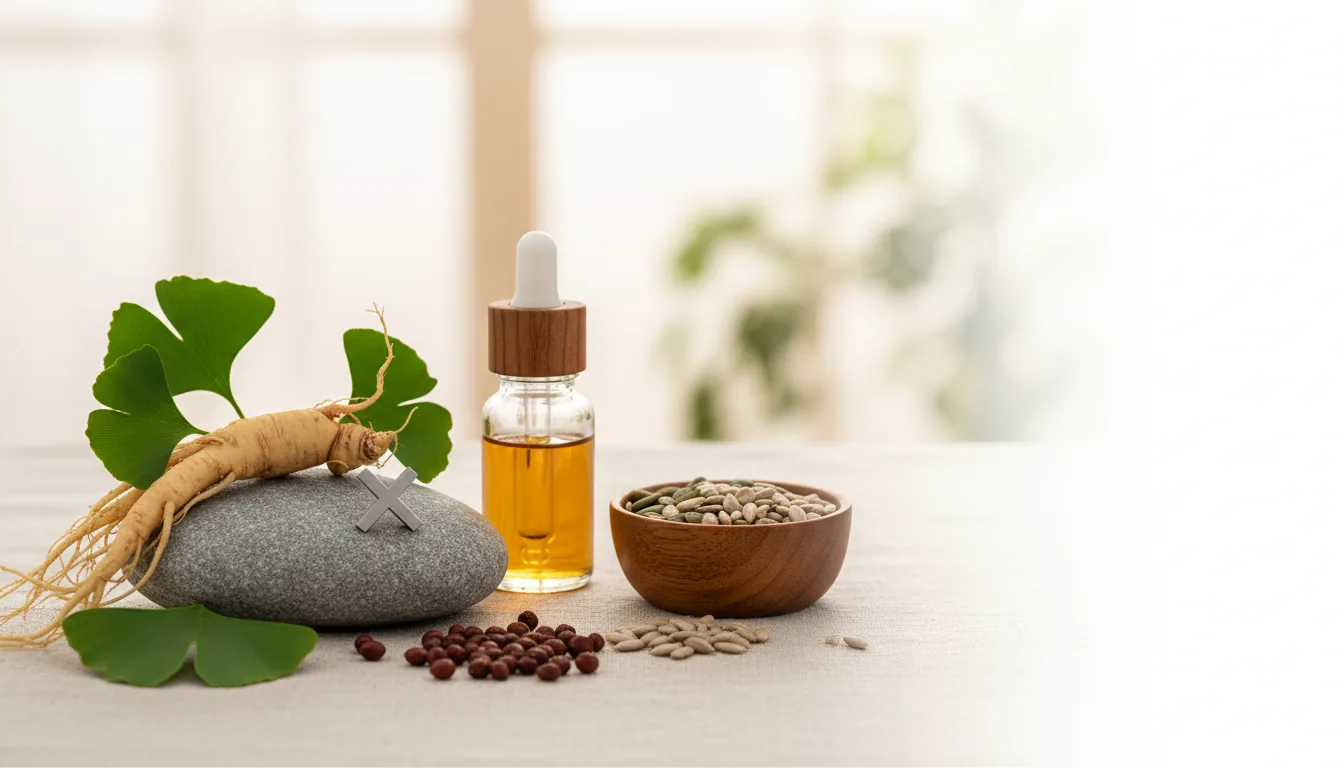
Eurycoma longifolia root contains several classes of compound: quassinoids, glycosaponins, polysaccharides and a group of small peptides. Eurycomanone is a quassinoid, and it became the industry's marker compound for a practical reason rather than a purely biological one — it is abundant enough, stable enough and distinctive enough to be quantified reliably in a laboratory.
That is what "standardisation" means in practice. A standardised extract is one manufactured so that a named compound falls within a stated range in every batch, and verified by an analytical method. The two methods you will see cited for eurycomanone are HPLC (high performance liquid chromatography) and HPTLC (high performance thin-layer chromatography). Both are real, validated techniques. Both produce a number a third party can reproduce.
A marker compound is not the same as "the active ingredient", and this is where a lot of marketing overreaches. Eurycomanone is a quality-control handle. It is a way of confirming that two batches are comparable and that the material is genuinely Eurycoma longifolia. Whether it is the compound responsible for the effects seen in the trials is a separate question, and one the trials themselves were not designed to answer — they tested whole standardised extracts, not isolated eurycomanone.
What the clinical extracts were actually standardised to
This is the table the vendor pages competing for this keyword do not publish, and it is the single most useful thing on this page. Every row below comes from the primary document, not from a supplier's summary of it.
| Extract | Type | Standardisation stated | Daily dose in trial | Trial | Outcome |
|---|---|---|---|---|---|
| Physta | Standardised aqueous (water) root extract | Eurycomanone 0.8–1.5%; total protein ≥22%; total polysaccharide 30%; glycosaponin 40% | 100 mg and 200 mg | Chinnappan S.M. et al., Food & Nutrition Research 2021;65:5647 (PMC8254464). Randomised, double-blind, placebo-controlled, multicentre. 105 men aged 50–70 with baseline total testosterone below 300 ng/dL, 12 weeks, measured at weeks 2, 4, 8 and 12 | Total testosterone significantly above placebo at week 12 on 100 mg (P=0.04), and at weeks 4 (P=0.01), 8 (P=0.002) and 12 (P<0.001) on 200 mg. Ageing Male Symptoms and Fatigue Severity scores significantly reduced from week 2 (P<0.001) |
| Physta (earlier trial, same extract family) | Freeze-dried water extract | Described in the paper as a freeze-dried water extract with a drug-to-extract ratio of 20:1 | 300 mg (4 × 75 mg) | Ismail S.B. et al., Evid Based Complement Alternat Med 2012;2012:429268 (PMC3518798). Randomised, placebo-controlled. 109 men aged 30–55, 12 weeks | Significant improvement in the Physical Functioning domain of SF-36 (P=0.006); safety parameters comparable to placebo |
| Standardised hot-water root extract | Aqueous root extract | Reported as a standardised hot-water extract; the paper does not publish a eurycomanone percentage | 200 mg | Talbott S.M. et al., J Int Soc Sports Nutr 2013;10:28 (PMID 23705671). 63 moderately stressed adults (32 men, 31 women), 4 weeks | Cortisol −16%, salivary testosterone +37%, Tension −11%, Anger −12%, Confusion −15% versus placebo |
| EU novel food specification | Standardised water extract of the root | Eurycomanone 0.8–1.5%; glycosaponins 40–65%; proteins 22–45%; polysaccharides 30–55% | Up to 200 mg/day proposed for adults | EFSA NDA Panel, EFSA Journal 2021;19(12):e06937 — a regulatory safety assessment, not an efficacy trial | The Panel reported positive findings in an in vitro chromosome aberration test and an in vivo comet assay in rats, and concluded that the safety of the novel food "has not been established under any condition of use" |
The doses in that table are covered in more depth in our guide to what the Tongkat Ali trials actually dosed. Here the column that matters is the third one.
Read the standardisation column top to bottom. The best-evidenced Tongkat Ali extract in the world — the one that produced a significant testosterone result in a 105-man randomised controlled trial, and the one a European regulator assessed in detail — is standardised to 0.8–1.5% eurycomanone. Not 5%. Not 10%.
That number is not an accident. It corresponds to the Malaysian national standard MS 2409, which specifies freeze-dried water extract of Tongkat Ali root and is the specification both the trial extract and the EFSA-assessed extract conform to. We have seen MS 2409 described on supplier pages with various embellishments about who wrote it; we have not verified those attributions and have left them out. What we can verify is that two independent primary documents — a peer-reviewed RCT and an EFSA opinion — both state the same 0.8–1.5% range for the extract they describe.
Why an extract ratio like 100:1 is not a measurement
A plant-to-extract ratio, sometimes written as a drug-to-extract ratio or DER, states how much raw plant material the manufacturer says was used to produce one part of finished extract. A 100:1 claim means 100 kg of root allegedly yielded 1 kg of extract.
Notice what that sentence does not contain: any statement about what is in the capsule. A ratio is a claim about a process, made by the party selling the output of that process. It is not a result you can measure in the finished powder.
This is not our editorialising. A 2022 review in Frontiers in Pharmacology examined exactly this problem and found that certificates of analysis frequently carry ratio figures "that are not amenable to verification through methods of analysis". The same paper identifies the belief that "a higher ratio represents a stronger, and therefore better extract" as perhaps the most common misconception about botanical extracts, and points out that a high extraction ratio can simply reflect a partial extraction procedure — in other words, an inefficient process, not a concentrated product.
Extract yield depends on raw material quality, solvent, temperature, extraction time, growing conditions and whether specific constituents were deliberately concentrated or removed. Two 100:1 extracts made by different manufacturers can differ enormously. There is no reference standard for the starting material, no assay for the ratio itself, and no way for a buyer to check any of it.
It is worth noting that the best-documented clinical extract in the table above carries a stated ratio of 20:1. If ratios worked the way the marketing implies, a 200:1 product would be ten times stronger than the extract that actually produced the trial results. It is not. It is a different extract, made a different way, with no trial behind it.
Ratio versus percentage, in one line. A ratio tells you what the manufacturer says went in. An assay-backed percentage tells you what a laboratory measured coming out. Only the second one describes the capsule you are going to swallow.
Does a higher eurycomanone percentage make a better extract?
The entire high-percentage segment of this market rests on an assumption that nobody in the top search results tests: that more eurycomanone means more effect. It is an intuitive assumption. It is also, at present, unevidenced.
Here is the problem in plain terms. The randomised controlled trials that produced the results everyone cites — the testosterone rise in older men, the cortisol reduction in stressed adults, the mood scores — were run on standardised water extracts in the 0.8–1.5% range. Products marketed at 2%, 5% or 10% eurycomanone are made by different processes and have, as far as we can establish, no randomised human trials of their own. Marketing a higher number as an upgrade means extrapolating from trials the product was not in.
There is a second argument against the "higher is better" reflex that gets very little airtime. The standardised water extracts are specified not just on eurycomanone but on glycosaponin, polysaccharide and protein fractions too. A process that concentrates quassinoids aggressively will change those other fractions as well. Whether that matters is unknown — but it does mean a high-eurycomanone concentrate is not simply "the same extract, more of it".
Several vendors publish their own comparative testing of competitors' extracts, typically by HPTLC, with results that flatter their own products. That testing may well be accurate. It is also self-published, unaudited, and produced by a party with a direct commercial interest in the outcome, so we do not reproduce those figures here as fact. If a vendor's percentage claim matters to your decision, ask for a third-party certificate of analysis for the specific lot you are buying.
We have also seen a specific "safe upper limit" figure for eurycomanone circulating on supplier blogs. We could not trace it to a regulatory document, a toxicology study or any peer-reviewed source, so we are not publishing the number. What can be said honestly is narrower and more useful: human trial data exists for extracts in the 0.8–1.5% band, and does not exist for the high-percentage concentrates. Absence of trial data is not evidence of harm, but it is not reassurance either.
Check the panel, not the front of the box
Before you buy any Tongkat Ali formula, open the Supplement Facts panel and look for a named bioactive with a stated percentage. That one line separates a standardised extract from a marketing claim.
Order From Official StoreWhat independent testing found in products already on the shelf
All of the above assumes the label is accurate. Two peer-reviewed analyses suggest that assumption fails often enough to matter, and neither is cited by any of the vendor pages currently ranking for this topic.
| Study | What was tested | Method | What was found |
|---|---|---|---|
| Abubakar B.M., Salleh F.M., Omar M.S., Wagiran A. — Pharmaceutical Biology 2018;56(1):368–377 (PMID 30058427) | 11 commercial Tongkat Ali herbal products | DNA barcoding (ITS2 marker) plus HPLC quantification of eurycomanone | 37% of products were authentic and 27% were adulterated; four products yielded no amplifiable DNA. Three contained an entirely different plant species — Holcoglossum sp., Nigella sativa and Ficus deltoidea. Eurycomanone in the authentic products measured 0.2%, 0.5% and 0.7%, all below the 0.8–1.5% specification, against 6.11% in the reference root extract |
| Norhidayah A., Vejayan J., Yusoff M.M. — Journal of Applied Sciences 2015;15(7):999–1005 | 41 commercial Tongkat Ali products, local and international | HPLC quantification of eurycomanone | 24 products had detectable eurycomanone; 17 had none detected despite being registered products. Measured levels among those containing it ranged widely. The authors recommended that eurycomanone content be made a mandatory regulatory parameter |
Put those two findings next to the marketing argument about 2% versus 10% and the priority ordering changes. Arguing about the top of the range is a second-order problem when independent laboratories keep finding products at the bottom of it, or off it entirely. The first question is not "how high is the percentage" but "is there a percentage at all, and did anyone independent check it".
Three questions to ask a label — and what Primordial Vigor X does not answer
The three-question test
- Is a bioactive named? Does the panel say "eurycomanone", or does it just say "extract"? An unnamed marker cannot be verified by anyone.
- Is a percentage stated? A number attached to that named compound — not a ratio, not "standardised", not "premium". If the only number is 100:1 or 200:1, you have a manufacturing claim rather than a measurement.
- Is there third-party assay evidence for that percentage? A certificate of analysis from an independent laboratory, ideally traceable to the lot number on your bottle. Self-published vendor testing is a starting point, not a verification.
Applying that test to the product this site covers gives an honest and slightly uncomfortable answer. Primordial Vigor X names Tongkat Ali (Eurycoma longifolia) as one of three botanicals in an 870 mg once-daily blend, alongside Tribulus terrestris and saw palmetto berry. We have not been able to verify a published eurycomanone percentage, an extract ratio, or a per-ingredient milligram figure for it anywhere.
So we do not claim it delivers a trial-comparable dose of anything, because we cannot show that it does. Question one is answered by the label; questions two and three are not. If you are buying specifically for the Tongkat Ali, check the Supplement Facts panel on the official store for a standardisation line before assuming the trial numbers in the table above apply. That is the same instruction we give in our guide to reading a proprietary blend panel, and it applies here without an exemption.
What the evidence does not show
Several things are genuinely unresolved, and it is more useful to name them than to write around them.
Eurycomanone has not been shown to be the active compound. Every trial in the table tested a whole standardised extract. None isolated eurycomanone and tested it against placebo in humans. It is a validated quality marker; treating it as the mechanism goes beyond the data.
There is no dose-response curve across percentages. No randomised trial has compared, say, a 1% extract against a 5% extract at matched doses. Until one does, "higher percentage" is a manufacturing specification, not a clinical claim.
The safety picture at high concentrations is thin, and one regulator was not satisfied at conventional ones. In its 2021 opinion the EFSA panel reported a positive in vitro chromosome aberration test and a statistically significant increase in DNA damage in the stomach and duodenum of rats in an in vivo comet assay at the high dose of 2,000 mg per kg of body weight per day, and concluded the safety of the extract "has not been established under any condition of use". Two honest qualifications belong with that: this is animal evidence at a dose vastly higher than any human intake, and it was a regulatory decision about authorising a novel food in the EU, not a finding of harm in people. Separately, the NIH LiverTox database records that in short-term clinical studies adverse effects were uncommon and minimal with no changes in ALT, AST, GGT or bilirubin, while noting that the effects of long-term use and higher doses "have not been assessed in humans" and that "there is no standardization of purity and concentration of the extracts used".
Trial durations are short. The longest trials in the table ran 12 weeks. Nothing here tells you what happens over a year.
None of this makes Tongkat Ali a treatment for anything. It is a dietary supplement, and clinically low testosterone is a medical condition that requires diagnosis by a clinician rather than a capsule. If you have persistent fatigue, low mood or a change in libido, those are worth investigating properly, because they can be signs of something treatable. For the broader question of what the ingredient evidence does and does not support, see our review of Tongkat Ali, Tribulus and saw palmetto.
Medical note: this article is general information about herbal extract standardisation, not medical advice. These statements have not been evaluated by the Food and Drug Administration. Dietary supplements are not intended to diagnose, treat, cure or prevent any disease. Speak to a healthcare professional before starting any supplement, especially if you take medication, have liver disease, or are managing a prostate or hormonal condition. Individual results vary. This product is for adult men only.
Frequently asked questions
What eurycomanone percentage should I look for in Tongkat Ali?
The extracts with the strongest human evidence sit at 0.8 to 1.5% eurycomanone. That is the specification of the Physta aqueous root extract used in the ageing-male randomised trial, and it is also the specification EFSA assessed in its 2021 novel food opinion. There is no published trial showing that a higher percentage produces a better clinical outcome, so treat 0.8 to 1.5% as the evidenced range rather than a floor to beat.
What does a 100:1 or 200:1 Tongkat Ali extract mean?
It is a plant-to-extract ratio, meaning the manufacturer says 100 or 200 parts of raw root produced one part of finished extract. It is not a measurement of anything in the capsule. A 2022 review in Frontiers in Pharmacology found that ratios are often not verifiable by any method of analysis, and called the belief that a higher ratio means a stronger extract perhaps the most common misconception in this area. A high ratio can even reflect a partial extraction.
Is a higher eurycomanone percentage better?
Not on the current evidence. The most-trialled Tongkat Ali extract is a standardised water extract in the 0.8 to 1.5% eurycomanone range, not a high-eurycomanone concentrate. High-percentage extracts of 5 to 10% are sold and marketed heavily, but we could not locate a randomised human trial showing they outperform the water extracts. Higher is a different product, not a proven upgrade.
How can I tell if a Tongkat Ali product contains what it claims?
Independent testing suggests you often cannot tell from the label alone. A 2018 study in Pharmaceutical Biology used DNA barcoding and HPLC on 11 commercial products and found 27% were adulterated, with three containing a completely different plant species. A 2015 analysis of 41 products found 17 with no detectable eurycomanone at all. Look for a named bioactive, a stated percentage, and third-party assay evidence for that percentage.
Does Primordial Vigor X publish a eurycomanone standardisation?
It names Tongkat Ali as one of three botanicals in an 870 mg daily blend, but we have not been able to verify a published eurycomanone percentage, extract ratio or per-ingredient milligram figure for it. So we do not claim the product delivers a trial-comparable dose of anything. Check the Supplement Facts panel on the official store for a standardisation line before assuming trial-comparable potency.
Scientific references
- Chinnappan S.M., George A., Pandey P., Narke G., Choudhary Y.K. — Effect of Eurycoma longifolia standardised aqueous root extract (Physta) on testosterone levels and quality of life in ageing male subjects: a randomised, double-blind, placebo-controlled multicentre study. Food & Nutrition Research 2021;65:5647. PMC8254464
- Ismail S.B. et al. — Randomized Clinical Trial on the Use of PHYSTA Freeze-Dried Water Extract of Eurycoma longifolia. Evid Based Complement Alternat Med 2012;2012:429268. PMC3518798
- Talbott S.M., Talbott J.A., George A., Pugh M. — Effect of Tongkat Ali on stress hormones and psychological mood state in moderately stressed subjects. J Int Soc Sports Nutr 2013;10:28. PMID 23705671
- EFSA Panel on Nutrition, Novel Foods and Food Allergens — Safety of Eurycoma longifolia (Tongkat Ali) root extract as a novel food pursuant to Regulation (EU) 2015/2283. EFSA Journal 2021;19(12):e06937
- Monagas M., Brendler T., Brinckmann J. et al. — Understanding plant to extract ratios in botanical extracts. Frontiers in Pharmacology 2022;13:981978
- Abubakar B.M., Salleh F.M., Omar M.S., Wagiran A. — Assessing product adulteration of Eurycoma longifolia (Tongkat Ali) herbal medicinal product using DNA barcoding and HPLC analysis. Pharmaceutical Biology 2018;56(1):368–377. PMID 30058427
- Norhidayah A., Vejayan J., Yusoff M.M. — Detection and Quantification of Eurycomanone Levels in Tongkat Ali Herbal Products. Journal of Applied Sciences 2015;15(7):999–1005
- Leisegang K., Finelli R., Sikka S.C., Panner Selvam M.K. — Eurycoma longifolia (Jack) Improves Serum Total Testosterone in Men: A Systematic Review and Meta-Analysis of Clinical Trials. Medicina 2022;58(8):1047. PMID 36013514
- NIH LiverTox — Tongkat Ali. NCBI Bookshelf NBK609015
Three named botanicals, one daily capsule
Tongkat Ali, Tribulus and saw palmetto in an 870 mg once-daily formula, with a 60-day money-back guarantee handled by the seller.
Order Primordial Vigor X Now