Tongkat Ali Dosage: What the Clinical Trials Actually Used (Not What Labels Say)
Quick Answer: How Much Tongkat Ali Did the Studies Actually Use?
Between 100 mg and 400 mg a day of a standardised root extract — with 200 mg the most frequently trialled dose — but the number on a label only means something if the extract is standardised the same way the trial extract was. Almost every published human trial used one commercial preparation, Physta, a standardised water extract of Eurycoma longifolia root. The highest daily dose we could find in a published human trial was 300 mg. Capsules sold at 1,000 mg and above sit entirely outside the trial evidence.
- Most-trialled dose: 200 mg/day of standardised root extract.
- Full trialled range: 100 mg to 300 mg/day in the human studies we retrieved.
- The catch: "400 mg tongkat ali" on a label is a powder weight, not a potency.
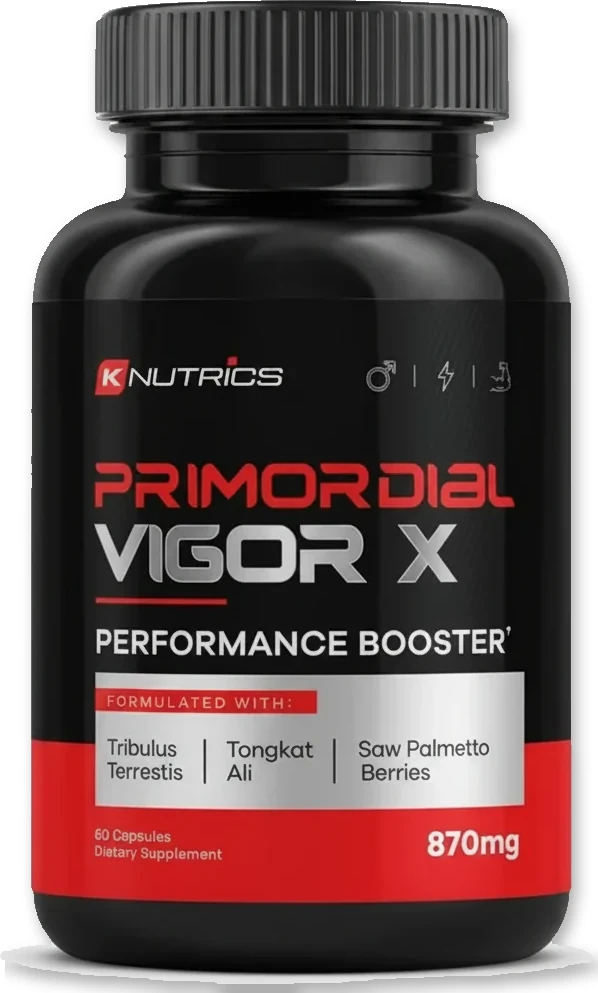
- Not comparable: Primordial Vigor X states an 870 mg three-botanical blend total, which is not a tongkat ali dose.
What the trials actually dosed, study by study
This is the table nobody publishes. Most dosage articles quote "200 to 400 mg" and move on, leaving the reader to assume those numbers came from somewhere. They did — from a small, fairly homogeneous set of randomised trials, most of which used the same standardised extract. Here is every one of them, with the population, the extract, the dose, the duration and what was actually measured.
| Study | Population | Extract / standardisation | Daily dose | Duration | Outcome measured | Result |
|---|---|---|---|---|---|---|
| Talbott SM et al., J Int Soc Sports Nutr 2013;10:28 | 63 moderately stressed adults (32 men, 31 women) | Physta standardised hot-water root extract — stated as 1% eurycomanone, 22% protein, 30% polysaccharides, 35% glycosaponin | 200 mg | 4 weeks | Salivary free cortisol and free testosterone; Profile of Mood States | Cortisol −16%, salivary free testosterone +37%, cortisol-to-testosterone ratio −36%; tension −11%, anger −12%, confusion −15% |
| Chinnappan SM et al., Food & Nutrition Research 2021;65 (multicentre RCT) | 105 men aged 50–70 with baseline total testosterone below 300 ng/dL (35 per arm) | Physta standardised aqueous root extract | 100 mg | 12 weeks | Serum total testosterone; Ageing Male Symptoms scale; Fatigue Severity Scale | Testosterone significantly above placebo at week 12 only (P<0.05); AMS and FSS significantly reduced from week 2 |
| Chinnappan SM et al., 2021 — second dose arm | Same trial, same population | Physta standardised aqueous root extract | 200 mg | 12 weeks | Serum total testosterone; AMS; FSS | Testosterone significantly above placebo at week 4 (P<0.05), week 8 (P<0.01) and week 12 (P<0.001); AMS and FSS significantly reduced from week 2 |
| Ismail SB et al., Evid Based Complement Alternat Med 2012;2012:429268 | 109 healthy men aged 30–55 | Physta freeze-dried water extract | 300 mg | 12 weeks | Quality of life (SF-36) and general well-being | SF-36 Physical Functioning domain significantly better than placebo at week 12 (P=0.028); safety parameters comparable to placebo |
| Leisegang K et al., Medicina 2022;58(8):1047 — systematic review and meta-analysis | 9 studies reviewed; 5 RCTs pooled, 232 men | Mixed, but most included trials used the same commercial extract | 100–400 mg across the pooled trials | 4–12 weeks | Serum total testosterone | Pooled SMD 1.352 (95% CI 0.565–2.138, p=0.001); larger in men starting below 300 ng/dL (SMD 1.861). High heterogeneity (I²=87.3%) and publication bias detected (Begg's p=0.0243) |
| NIH LiverTox, "Tongkat Ali", NCBI Bookshelf NBK609015 — safe upper bound | Reference database entry, not a trial | States there is no standardisation of purity or concentration across marketed extracts | Describes 100–400 mg as the typical dose; notes capsules of 1,000–1,600 mg are sold | n/a | Tolerability and liver enzymes | In short-term studies adverse effects were uncommon and minimal, with no changes in ALT, AST, GGT or bilirubin. Explicitly states the effects of long-term use and of higher doses have not been assessed in humans |
Read one row at a time. The single most useful column is not the dose — it is the extract column, because that is the one a label almost never lets you fill in.
Why 200 mg is the number that keeps appearing
Two hundred milligrams is not a round number someone picked for marketing. It is the dose in the most-cited trial in the category and the better-performing arm of the only dose-comparison study that exists.
Talbott and colleagues used 200 mg a day of Physta hot-water extract for four weeks in 63 moderately stressed adults, and reported a 16% fall in salivary cortisol alongside a 37% rise in salivary free testosterone. Two honest qualifiers belong next to that headline. First, the participants were men and women, so it is not a study of male vitality specifically. Second, the hormone measurements were salivary free testosterone, not serum total testosterone — a different measure that does not translate one-to-one into the blood test a clinician would order.
The 2021 multicentre trial by Chinnappan and colleagues is the one that directly compared doses. It randomised 105 men aged 50 to 70 whose baseline total testosterone was below 300 ng/dL to 100 mg, 200 mg or placebo for 12 weeks. The 200 mg arm separated from placebo at week 4 and stayed separated at weeks 8 and 12. The 100 mg arm only got there at week 12. That is the closest thing the literature has to a dose-response answer, and it points at 200 mg rather than 100 mg in that specific population.
Notice what that does not establish. No retrieved trial compared 200 mg against 400 mg. The popular belief that 400 mg is the "stronger" clinical dose is an extrapolation, not a finding. If you want the week-by-week detail of when each of these measurements landed, we broke it out separately in how long tongkat ali takes to work.
Dose is not dose: extract ratios, standardisation and root equivalents
The three things a milligram figure can mean
1. Raw root powder. Ground root, no extraction. 400 mg of raw root powder is not comparable to 400 mg of a concentrated extract in any way, and no trial in the table above used raw powder.
2. An extract sold by ratio (100:1, 200:1). This claims that 100 kg of starting material produced 1 kg of extract. It is not a measurement of anything in the finished capsule. There is no assay behind it, no reference standard for the starting root, and no way for a buyer to verify it.
3. A standardised extract with a named bioactive percentage. This is what the trials used. Talbott's extract was described as 1% eurycomanone with stated protein, polysaccharide and glycosaponin fractions. A percentage is a claim about the contents of the capsule, which is a categorically different kind of statement from a ratio.
The practical consequence: a bottle that says "Tongkat Ali 400 mg" and nothing else has told you the weight of a powder. It has not told you whether that powder resembles the extract in any published trial. Two capsules with identical milligram figures can be entirely different products.
This is the gap that the standard dosage article leaves open. It quotes trial doses and then implies that matching the number on a label reproduces the trial. It does not. The dose and the extract are a package, and the extract is the half that vendors are least likely to disclose.
How much is too much? What the safety literature actually says
The widely repeated line that "up to 1.2 g a day is safe" appears on a large number of supplement blogs. We could not trace it to any human trial. It appears to originate in an animal toxicity study extrapolated to an acceptable daily intake, which is a legitimate regulatory exercise but is not the same thing as a human safety finding, and we could not confirm the primary source. We are therefore not publishing it as a safe dose.
What we can source is more sober. NIH LiverTox states that adverse effects in short-term clinical studies were uncommon and minimal, with no changes in ALT, AST, GGT or bilirubin — and then says directly that the effects of long-term use and of higher doses have not been assessed in humans. It assigns tongkat ali a likelihood score of D, meaning a possible rare cause of clinically apparent liver injury, and notes that the reported injury cases have tended to occur in bodybuilders where unacknowledged anabolic steroid use weakens any attribution.
There is also a regulatory view that rarely gets quoted in supplement copy. In an opinion adopted on 27 October 2021, the European Food Safety Authority's NDA Panel assessed a standardised tongkat ali root water extract proposed for food-supplement use at up to 200 mg a day. The Panel reported a positive in vitro chromosome aberration test and a positive in vivo comet assay at the highest dose tested, 2,000 mg per kg of body weight, in tissues at the first site of contact. It concluded that the safety of the novel food had not been established under any condition of use. That is a conclusion about one specific extract dossier in one regulatory framework, and it is not a finding that anyone was harmed. It is still the single most cautious formal assessment on the record, and leaving it out would be dishonest.
Medical note: this article is general information, not medical advice, and nothing here is a dosing recommendation. Follow the label on the product you actually purchased. Speak to a healthcare professional before starting any supplement, particularly if you take prescription medication, have a liver condition, are being treated for a prostate or hormonal condition, or have surgery scheduled. This product is for adult men only.
Check the panel before you check out
Primordial Vigor X is a once-daily 870 mg three-botanical capsule. See the current Supplement Facts panel, pricing and the 60-day guarantee on the official store.
Order Primordial Vigor X NowWhat this means for an 870 mg blend
Primordial Vigor X publishes an 870 mg total for a once-daily capsule containing three named botanicals: Tribulus terrestris, Tongkat Ali (Eurycoma longifolia) root and saw palmetto berry. That 870 mg is the blend total. It is not a tongkat ali dose, and it should not be read as one.
Run the arithmetic and you can see why the distinction matters. An even three-way split of 870 mg gives 290 mg each, which would land inside the trialled range. But an even split is an assumption, not a disclosure. Supplement Facts panels list blend ingredients in descending order of weight, so all a blend total plus an ingredient order actually guarantees is that the first-listed ingredient is the heaviest. The third could be a small fraction of the total. Without a per-ingredient breakdown, 290 mg is a ceiling for the smallest component, not an estimate of it.
There is a second unknown on top of the first. Even if the tongkat ali portion were 290 mg, no standardisation figure is published — no eurycomanone percentage, no extract type. Every dose in the table above refers to a standardised water extract. Without that information, none of those rows can be mapped onto this product, and we are not going to pretend otherwise. Our full Primordial Vigor X review takes the same position on the rest of the label.
What to do instead: before buying any male-vitality formula, open the Supplement Facts panel on the official store and look for three lines — a per-ingredient milligram figure rather than a blend total, an extract type for the tongkat ali, and a named bioactive with a percentage. A product that gives you all three can be compared to the trials. A product that gives you none of them cannot, whatever its front label says.
What the evidence does not show
Being straight about the limits is the whole point of a dosage article, so here they are.
- No optimal dose has been established. One trial compared two doses in one narrow population. That is not a dose-response curve. Anyone quoting an "optimal" milligram figure is inferring.
- The evidence base is small and narrow. The meta-analysis pooled five RCTs and 232 men, found high heterogeneity (I² = 87.3%) and detected publication bias. Its authors said explicitly that more research is required before clinical use. A statistically significant pooled effect from a small, heterogeneous, possibly biased literature is a promising signal, not a settled fact.
- Most of the evidence rests on one commercial extract. When most included trials use the same preparation, the findings belong to that preparation as much as to the botanical.
- Effects were clearest in men starting low. The subgroup effect was larger in men with baseline testosterone under 300 ng/dL. There is far less to say about a healthy man with normal levels.
- Nothing here is a treatment. Tongkat ali is a dietary supplement ingredient. It is not a treatment for clinically low testosterone, and persistent fatigue or low drive is worth investigating with a clinician rather than dosing around.
- Long-term dosing is unstudied. The trials cap out at about 12 weeks. "Well tolerated for 12 weeks in screened participants" is the actual claim; "safe long term" is not.
For the broader question of whether these botanicals hold up at all, see our evidence review of Tongkat Ali and Tribulus for testosterone and male vitality.
Frequently asked questions about tongkat ali dosage
How much tongkat ali should I take per day?
The published human trials retrieved for this article used between 100 mg and 400 mg a day of a standardised root extract, and 200 mg is the dose that appears most often. Higher-dose capsules are sold, but NIH LiverTox states plainly that the effects of long-term use and of higher doses have not been assessed in humans. Follow the label on the product you actually bought, and speak to a clinician first if you take prescription medication.
Is 200 mg or 400 mg of tongkat ali better?
No retrieved trial compared 200 mg against 400 mg head to head, so there is no evidence-based answer. The one dose comparison that does exist ran 100 mg against 200 mg in 105 men aged 50 to 70, and the 200 mg arm separated from placebo earlier and more strongly. That supports 200 mg over 100 mg in that population. It does not show that 400 mg beats 200 mg.
Does 400 mg on a label mean the same as 400 mg in a study?
Not necessarily. The trial doses refer to specific standardised extracts, and most of the published work used one preparation, a standardised water extract of the root. A label that says 400 mg tongkat ali without naming an extract type, a bioactive or a percentage is telling you the weight of a powder, not its potency. Two capsules with identical milligram figures can be very different products.
What does the 870 mg on the Primordial Vigor X label mean?
It is the total for a three-botanical blend of Tribulus terrestris, Tongkat Ali and saw palmetto berry. It is not a tongkat ali dose. The per-ingredient split and any standardisation are not published, so that 870 mg cannot be mapped onto any of the trial doses in the table above. Check the Supplement Facts panel on the official store before you buy.
Is 1.2 grams of tongkat ali a day safe?
We could not trace that figure to any human trial. It circulates widely on supplement blogs and appears to derive from an animal toxicity extrapolation rather than a clinical study, so we are not repeating it as a safe dose. The highest daily dose in the human trials we retrieved was 300 mg, and in 2021 the European Food Safety Authority concluded that the safety of a tongkat ali root extract had not been established under any condition of use.
Scientific references
- Talbott SM, Talbott JA, George A, Pugh M. Effect of Tongkat Ali on stress hormones and psychological mood state in moderately stressed subjects. J Int Soc Sports Nutr 2013;10:28. PMID 23705671, DOI 10.1186/1550-2783-10-28
- Chinnappan SM, George A, Pandey P, Narke G, Choudhary YK. Effect of Eurycoma longifolia standardised aqueous root extract on testosterone levels and quality of life in ageing male subjects: a randomised, double-blind, placebo-controlled multicentre study. Food & Nutrition Research 2021;65. DOI 10.29219/fnr.v65.5647
- Ismail SB, Wan Mohammad WMZ, George A, et al. Randomized clinical trial on the use of a freeze-dried water extract of Eurycoma longifolia for the improvement of quality of life and well-being in men. Evid Based Complement Alternat Med 2012;2012:429268. PMID 23243445
- Leisegang K, Finelli R, Sikka SC, Panner Selvam MK. Eurycoma longifolia (Jack) improves serum total testosterone in men: a systematic review and meta-analysis of clinical trials. Medicina 2022;58(8):1047. DOI 10.3390/medicina58081047
- NIH LiverTox: Clinical and Research Information on Drug-Induced Liver Injury — Tongkat Ali. NCBI Bookshelf NBK609015
- EFSA Panel on Nutrition, Novel Foods and Food Allergens. Safety of Eurycoma longifolia (Tongkat Ali) root extract as a novel food pursuant to Regulation (EU) 2015/2283. EFSA Journal 2021;19(12):6937. DOI 10.2903/j.efsa.2021.6937
See the Primordial Vigor X label for yourself
Tribulus, Tongkat Ali and saw palmetto in one daily 870 mg capsule — with a 60-day money-back guarantee handled by the seller.
Order From Official Store