How Long Tongkat Ali Takes to Work: A Week-by-Week Timeline From the Trial Data
Quick Answer: How Long Does Tongkat Ali Take to Work?
The earliest point at which any published trial measured a change is week 2 — and what moved then was self-reported fatigue and symptom scores, not hormones. Testosterone did not separate from placebo until week 4, and only in the higher dose arm. The fuller picture, including the lower dose, landed at weeks 8 and 12. That is why an honest trial window is 8 to 12 weeks and not ten days.
- Week 2: fatigue and ageing-male symptom scores fell significantly in both dose arms of a 12-week randomised trial.
- Week 4: first significant testosterone separation from placebo, at 200 mg only.
- Weeks 8–12: effect strengthened; the 100 mg arm reached significance only at week 12.
- Nothing before week 2: no trial we retrieved measured anything earlier, so a day-10 verdict has no data behind it.
The timeline, anchored to what was actually measured
Most timeline articles in this category state "4 to 8 weeks" or "8 to 12 weeks" and stop. That is a summary of a conclusion, not a timeline, and it gives you nothing to check yourself against. A real timeline has to be built from the measurement schedule of the trials themselves.
Two studies carry most of the weight here. Chinnappan and colleagues ran a randomised, double-blind, placebo-controlled multicentre trial in 105 men aged 50 to 70 whose baseline total testosterone was below 300 ng/dL, comparing 100 mg and 200 mg a day of a standardised aqueous root extract against placebo, with assessments at weeks 2, 4, 8 and 12. Talbott and colleagues ran a four-week study at 200 mg a day in 63 moderately stressed adults. Between them, they define every timepoint below.
| Window | What was measured in trials at this point | What the data showed | What you can realistically judge |
|---|---|---|---|
| Days 1–13 | Nothing. No retrieved trial took an efficacy reading before week 2. | No data exists for this window in either direction. | Only tolerance. Whether the capsule sits well with you, and whether you can actually remember to take it daily. |
| Week 2 | Chinnappan 2021: Fatigue Severity Scale and Ageing Male Symptoms scale. Testosterone also drawn. | FSS fell significantly from baseline in both arms (100 mg: 57.5 to 52.7; 200 mg: 57.9 to 50.3; P<0.001). AMS fell significantly in both arms. Placebo did not change. Testosterone had not separated from placebo. | The first honest checkpoint, and it is subjective: energy and general symptom burden. Do not read anything hormonal into week 2. |
| Week 4 | Chinnappan 2021: testosterone, FSS, AMS. Talbott 2013 endpoint: salivary cortisol, salivary free testosterone and mood. | Chinnappan: 200 mg arm significantly above placebo on total testosterone (P<0.05); 100 mg arm not yet. FSS and AMS continued to fall in both arms. Talbott: cortisol −16%, salivary free testosterone +37%, cortisol-to-testosterone ratio −36%; tension −11%, anger −12%, confusion −15%. | The first point at which a hormonal change has ever been demonstrated. Still early, and only at the higher dose. |
| Week 8 | Chinnappan 2021: testosterone, FSS, AMS. | 200 mg arm significantly above placebo on testosterone with a stronger p-value (P<0.01). FSS at 40.3 (100 mg) and 35.7 (200 mg) versus 58.3 in placebo. 100 mg arm still not significant on testosterone. | A fair mid-point review. If nothing at all has shifted by now, that is meaningful information. |
| Week 12 | Chinnappan 2021 endpoint: testosterone, FSS, AMS. Ismail 2012 endpoint: SF-36 quality of life at 300 mg/day. | Both arms significantly above placebo on testosterone (100 mg P<0.05, 203.8 ng/dL; 200 mg P<0.001, 225.0 ng/dL; placebo 177.9 ng/dL). FSS 33.6 and 29.2 versus 58.5 placebo. AMS 35.4 and 26.7 versus 58.1. Ismail: SF-36 Physical Functioning significantly better than placebo (P=0.028). | The strongest evidence point in the whole literature. This is the fair place to make a decision. |
| Beyond 12 weeks | Nothing. NIH LiverTox states the effects of long-term use have not been assessed in humans. | No efficacy data and no safety data past roughly 12 weeks. | Nothing evidence-based. Continuing past 12 weeks is a personal decision made outside the trial record. |
Values for the Fatigue Severity Scale and Ageing Male Symptoms scale are within-group changes from baseline, with placebo shown for comparison. Lower is better on both scales.
Week 2: the first thing that moved was how men felt
This is the finding that most timeline articles miss entirely, and several state the opposite of. In the Chinnappan trial, both the 100 mg and 200 mg arms recorded a statistically significant fall in Fatigue Severity Scale scores as early as week 2, and the same was true of the Ageing Male Symptoms scale. The placebo group's scores barely moved across the whole 12 weeks, which makes the contrast more interesting than a within-group change on its own would be.
Read that carefully, though, because it is easy to overclaim. These are self-report questionnaires. Men who feel they are doing something about a problem tend to score questionnaires more favourably, and the fact that the placebo group did not drift is reassuring rather than conclusive. Nothing hormonal had happened by week 2 in the same trial. So the honest reading of week 2 is: the earliest measured change is a subjective one, and it is not evidence that anything biochemical has shifted yet.
It also means you should be sceptical of the widely repeated claim that "some studies show testosterone improvements after just two weeks". We looked for a two-week testosterone timepoint and did not find one in any retrieved trial. In the one trial that actually took a week-2 reading, testosterone had not separated from placebo.
Week 4: the first hormonal signal, and only at the higher dose
Week 4 is where the timeline stops being subjective. Two independent trials both took readings here and both found something.
In Chinnappan's dose comparison, the 200 mg arm's total testosterone rose significantly above placebo at week 4 (P<0.05). The 100 mg arm did not. That single detail is the most practically useful thing in this whole article, because it means "how long does it take" has a second variable inside it: at 100 mg the answer in that trial was twelve weeks, and at 200 mg it was four.
Talbott's four-week study is the other anchor. At 200 mg a day in moderately stressed adults, salivary cortisol fell 16% and salivary free testosterone rose 37% against placebo, with mood subscale improvements of 11 to 15%. Two caveats travel with those numbers. The participants were men and women, so this is not a male-specific result, and salivary free testosterone is not the same measurement as the serum total testosterone a clinician would order.
If you want the dose side of this properly laid out, with every trial dose and extract in one table, we covered it in tongkat ali dosage: what the clinical trials actually used.
Weeks 8 and 12: where the evidence is actually strongest
The 200 mg arm's testosterone advantage over placebo strengthened at week 8 (P<0.01) and again at week 12 (P<0.001). The 100 mg arm crossed into significance for the first time at week 12. Fatigue and symptom scores kept falling steadily in both arms across all four timepoints while placebo stayed flat.
Week 12 is also the endpoint of the second twelve-week study, in which 109 men aged 30 to 55 took 300 mg a day of a freeze-dried water extract and finished with a significantly better SF-36 Physical Functioning score than placebo. Different population, different dose, same endpoint, and a consistent direction.
So the honest headline is not "tongkat ali works in four weeks". It is that the strongest, most consistent, most replicated evidence sits at the twelve-week mark, and the four-week signal is real but narrow — one dose, one trial, one population.
Give it a fair trial window
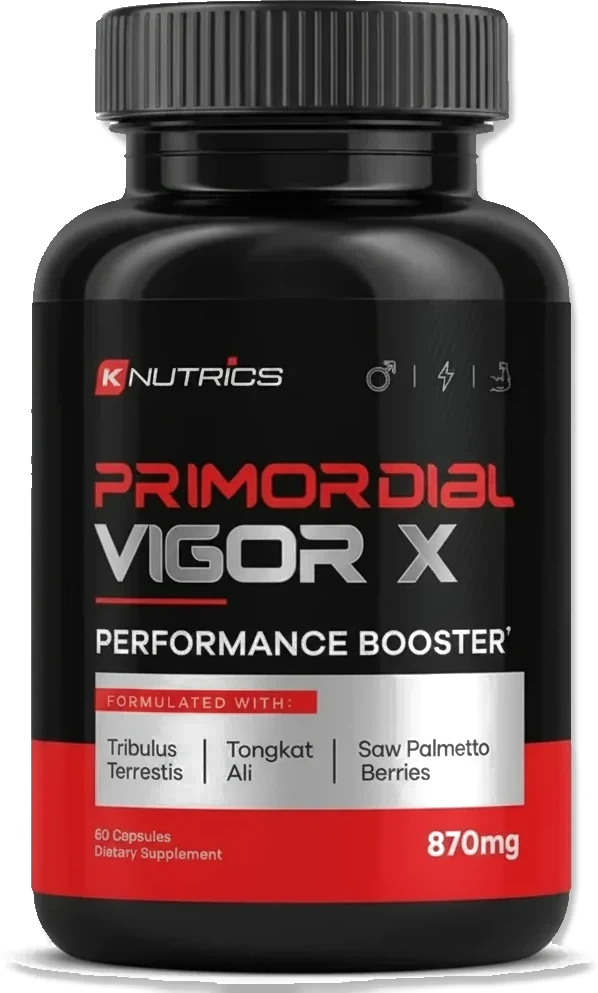
Primordial Vigor X is a once-daily capsule with a stated 8 to 12 week window and a 60-day money-back guarantee handled by the seller. See current pricing and the label on the official store.
Order Primordial Vigor X NowWhat not to conclude at day 10
The most common way people get this wrong is to quit at ten days, or to declare success at ten days. Neither judgement has any data behind it, because no published trial measured anything at all before week 2.
Whatever you notice in the first fortnight is measuring something other than the botanical: the novelty of a new routine, an unrelated good or bad week of sleep, or the ordinary variation in how energetic anyone feels day to day. Testosterone itself varies substantially through the day, which is why the trials used standardised sampling rather than asking people how they felt at breakfast.
There is a practical corollary. Missed doses are the far likelier explanation for "it did nothing" than a formulation failure. Every trial in this literature dosed continuously, every day, with no breaks. If your actual adherence over eight weeks was five days out of seven, you did not run the trial you think you ran.
Does the time of day change how fast it works?
No trial we could find compared morning against evening dosing, or with-food against without-food, as a randomised variable. The published studies specify a daily dose and a duration, not a clock time. Every "best time to take tongkat ali" recommendation in circulation is therefore reasoning from theory rather than reporting a result.
The theories are not unreasonable — testosterone follows a daily rhythm that peaks in the morning, and some people find they sleep worse if they take anything stimulating late. But neither has been tested for this botanical. What the evidence does support is unglamorous: take it at whatever time you will reliably take it every day, because consistency across weeks is the variable the trials actually controlled.
What the evidence does not show
- No timeline exists for healthy men with normal testosterone. The trial that defines this schedule enrolled men aged 50 to 70 starting below 300 ng/dL. A 35-year-old with normal levels is not in that dataset.
- The evidence base is small. The supporting meta-analysis pooled five randomised trials and 232 men, reported high heterogeneity (I² = 87.3%) and detected publication bias. Its authors stated that more research is needed before clinical use.
- Most of it rests on one commercial extract. A timeline built from trials of one standardised preparation does not automatically transfer to a differently made extract, or to raw root powder.
- Nothing is known past 12 weeks. NIH LiverTox states directly that the effects of long-term use and of higher doses have not been assessed in humans.
- Week 2 is subjective, not biochemical. Fatigue and symptom questionnaires moved; hormones did not.
- This is not a treatment timeline. Tongkat ali is a dietary supplement ingredient, not a treatment for clinically low testosterone or any medical condition. Persistent fatigue or low drive warrants a clinician, not a longer wait.
For the underlying question of whether these ingredients hold up at all, see our evidence review of Tongkat Ali and Tribulus for testosterone and male vitality.
How this maps onto Primordial Vigor X
Primordial Vigor X states an 8 to 12 week window for its once-daily capsule. That happens to line up with the trial literature rather than with marketing convention — week 12 is where the evidence for this botanical is strongest, and 8 weeks is the mid-point review. It is also worth noting that the seller's 60-day money-back guarantee is roughly one trial length, which means a fair evaluation and the refund window overlap rather than fight each other.
One thing this article cannot do is tell you the product will follow that curve. Primordial Vigor X is a three-botanical 870 mg blend and does not publish a per-ingredient breakdown or a tongkat ali standardisation, so its tongkat ali content cannot be matched to any trial dose above. The timeline here belongs to the studied extracts at the studied doses. Read it as the shape of the evidence, then check the Supplement Facts panel yourself — our full Primordial Vigor X review takes the same approach to the rest of the label.
Medical note: this article is general information, not medical advice. Speak to a healthcare professional before starting any supplement, especially if you take prescription medication, have a liver condition, or are being treated for a prostate or hormonal condition. Saw palmetto, which appears alongside tongkat ali in many blends, can interact with blood thinners. This product is for adult men only.
Frequently asked questions about the tongkat ali timeline
How long does tongkat ali take to work?
In the published trials, the earliest measured change was at week 2, and it was a fall in self-reported fatigue and symptom scores rather than a hormonal change. Total testosterone did not separate from placebo until week 4, and only in the 200 mg arm. The strongest and most consistent results sit at week 12, which is why 8 to 12 weeks is a fair trial window.
Can you feel tongkat ali after one week?
There is no data either way, because no retrieved trial took a measurement before week 2. Anything noticed in the first fortnight is more likely to reflect a new routine, sleep, or ordinary day-to-day variation than the botanical itself. The only thing worth judging in week 1 is whether the capsule sits well with you.
Do some studies show testosterone improvements after two weeks?
We could not find one. That claim circulates on supplement blogs, but in the only retrieved trial that actually took a week-2 reading, testosterone had not separated from placebo at that point. What did change significantly at week 2 in that trial were the Fatigue Severity Scale and Ageing Male Symptoms scores, which are self-report questionnaires rather than hormone measurements.
Should I take tongkat ali in the morning or at night?
No trial we could find compared morning against evening dosing as a randomised variable, so every recommendation about timing is theory rather than a result. What the evidence does support is consistency: the trials dosed daily with no breaks, so the practical answer is to take it at whatever time you will reliably take it every day.
How long should I give it before deciding it is not working?
Week 8 is a fair mid-point review and week 12 is the fair decision point, because week 12 is where the evidence in this literature is strongest and where the lower dose arm finally reached significance. Judging at day 10 is measuring the adjustment period. If persistent fatigue or low drive is the reason you are asking, that is worth raising with a clinician rather than waiting longer.
Scientific references
- Chinnappan SM, George A, Pandey P, Narke G, Choudhary YK. Effect of Eurycoma longifolia standardised aqueous root extract on testosterone levels and quality of life in ageing male subjects: a randomised, double-blind, placebo-controlled multicentre study. Food & Nutrition Research 2021;65. DOI 10.29219/fnr.v65.5647
- Talbott SM, Talbott JA, George A, Pugh M. Effect of Tongkat Ali on stress hormones and psychological mood state in moderately stressed subjects. J Int Soc Sports Nutr 2013;10:28. PMID 23705671, DOI 10.1186/1550-2783-10-28
- Ismail SB, Wan Mohammad WMZ, George A, et al. Randomized clinical trial on the use of a freeze-dried water extract of Eurycoma longifolia for the improvement of quality of life and well-being in men. Evid Based Complement Alternat Med 2012;2012:429268. PMID 23243445
- Leisegang K, Finelli R, Sikka SC, Panner Selvam MK. Eurycoma longifolia (Jack) improves serum total testosterone in men: a systematic review and meta-analysis of clinical trials. Medicina 2022;58(8):1047. DOI 10.3390/medicina58081047
- NIH LiverTox: Clinical and Research Information on Drug-Induced Liver Injury — Tongkat Ali. NCBI Bookshelf NBK609015
Start the 12-week clock
Tribulus, Tongkat Ali and saw palmetto in one daily 870 mg capsule — no subscription, and a 60-day guarantee handled by the seller.
Order From Official Store