Tongkat Ali vs Ashwagandha for Men: What Each One Is Actually Evidenced For
Quick Answer: Tongkat Ali or Ashwagandha — Which Should a Man Choose?
They are evidenced for different things, so the honest answer depends on the goal — Tongkat Ali has the better testosterone case, with a pooled effect size across five randomised trials, while ashwagandha's stronger record is in stress and sleep. Neither is a general-purpose upgrade, and neither is a treatment for anything.
- Testosterone: Tongkat Ali — pooled SMD 1.352 (95% CI 0.565–2.138, p = 0.001) across 5 RCTs.
- Stress and sleep: Ashwagandha — cortisol significantly lower than placebo (p = 0.0006) in a 60-day trial; sleep SMD −0.59 across 5 RCTs.
- Taking both: zero randomised trials have tested the combination. "No known interaction" is not the same as "tested".
- Safety signal to know: NIH LiverTox scores ashwagandha B (likely cause of liver injury) and Tongkat Ali D (possible rare cause).
Head to head: what each one is actually evidenced for
Comparison tables are everywhere for this pairing. Almost none carry a number. Below, every cell is tied to a named trial or review.
| Tongkat Ali (Eurycoma longifolia) | Ashwagandha (Withania somnifera) | |
|---|---|---|
| Best-evidenced use | Total testosterone in men starting from a low baseline; stress-hormone and mood markers | Perceived stress and serum cortisol; sleep quality |
| Trial dose range | 100–400 mg/day of standardised root extract in the main trials (100–600 mg across the full pooled set); 200 mg/day is the most frequently used | 300 mg twice daily (600 mg/day) of a full-spectrum root extract in the stress trial; 21 mg/day of withanolide glycosides in the hormone trial |
| Typical trial duration | 4 to 12 weeks | 8 weeks to 60 days |
| Effect size where measured | Pooled SMD 1.352 (95% CI 0.565–2.138, p = 0.001) for total testosterone across 5 RCTs (Leisegang K et al., Medicina 2022;58(8):1047). At 200 mg/day for 4 weeks: salivary cortisol −16%, salivary testosterone +37%, Tension −11%, Anger −12%, Confusion −15% (Talbott SM et al., J Int Soc Sports Nutr 2013;10:28) | Serum cortisol significantly lower than placebo (p = 0.0006) and all stress scales improved (p < 0.0001) in 64 adults over 60 days (Chandrasekhar K et al., 2012). Sleep SMD −0.59 (95% CI −0.75 to −0.42) across 5 RCTs and 400 participants (Cheah KL et al., PLoS One 2021). Salivary testosterone +14.7% versus placebo (p = .010) and DHEA-S +18% (p = .005) in 57 overweight men aged 40–70 (Lopresti AL et al., 2019) |
| Evidence quality | Meta-analysed, a genuine advantage — but on 5 small trials with very high heterogeneity (I² = 87.3%). On subgroup analysis the effect was significant in hypogonadal men and not significant in healthy men | More trials overall plus a sleep meta-analysis. The testosterone finding rests on one small crossover trial, in salivary rather than serum hormones, which found no significant difference in fatigue, vigour or sexual well-being |
| Known cautions | NIH LiverTox likelihood score D — possible rare cause of clinically apparent liver injury. LiverTox also notes long-term use and higher doses have not been assessed in humans, and there is no standardisation of purity and concentration across extracts | NIH LiverTox likelihood score B — likely cause of clinically apparent liver injury, with roughly 23 published cases, onset typically 2 to 12 weeks, usually cholestatic or mixed, mostly mild and self-limited but with rare severe cases reported |
Tongkat Ali: a pooled effect size, but read the subgroup analysis
Tongkat Ali has something almost no other men's botanical has: a formal meta-analysis of randomised controlled trials with a testosterone endpoint. Leisegang and colleagues reviewed nine studies, pooled five, and reported a standardised mean difference of 1.352 (95% CI 0.565–2.138, p = 0.001).
By convention an SMD of 0.8 is a large effect, so 1.352 reads as substantial. Two details keep it honest. The confidence interval is wide, which is what happens when you pool five small trials. And the reported heterogeneity was I² = 87.3%, meaning the trials disagreed with each other considerably. Most importantly, when the authors split the data by population, the improvement was significant in hypogonadal men and not significant in healthy men.
That subgroup result is the most useful sentence in the Tongkat Ali literature and it is almost never quoted on vendor pages. The effect appears where there is room for it. A man with normal levels should not expect the headline number.
The other well-known trial, Talbott and colleagues in 2013, gave 63 moderately stressed adults 200 mg a day of a standardised water extract for four weeks. These were salivary measures over a short window in a mixed-sex sample — a real result, but not the weight of serum measurements in a large trial.
Ashwagandha: strongest where men are not looking
Most men buy ashwagandha for testosterone. Its best evidence is elsewhere. The most-cited stress trial, by Chandrasekhar and colleagues in 2012, randomised 64 adults with chronic stress to 300 mg of a high-concentration full-spectrum root extract twice daily — 600 mg a day — or placebo for 60 days. Serum cortisol fell substantially relative to placebo (p = 0.0006) and every stress-assessment scale improved (p < 0.0001).
For sleep there is something better than a single trial. Cheah and colleagues pooled five randomised controlled trials in 400 participants in PLoS One in 2021 and found a small but significant improvement in overall sleep: SMD −0.59 (95% CI −0.75 to −0.42).
The testosterone claim is weaker than its reputation. Lopresti and colleagues ran a crossover trial in overweight men aged 40 to 70 with mild fatigue; 57 enrolled, 43 completed all 16 weeks. Salivary testosterone rose 14.7% more than placebo (p = .010) and DHEA-S 18% more (p = .005). But the same paper reports no significant between-group differences in cortisol, estradiol, fatigue, vigour or sexual well-being. One hormone marker moved; the things a man would actually notice did not.
Match the goal to the evidence
The comparison only becomes a decision once you name the goal.
| If your goal is… | Better-evidenced option | What was actually measured | The caveat |
|---|---|---|---|
| Raising total testosterone | Tongkat Ali | Pooled SMD 1.352 across 5 RCTs | Significant in hypogonadal men only; not significant in healthy men on subgroup analysis |
| Lowering perceived stress and cortisol | Ashwagandha | Serum cortisol and validated stress scales over 60 days at 600 mg/day | One trial, 64 participants, and a general-adult rather than male-specific sample |
| Improving sleep | Ashwagandha | Sleep SMD −0.59 across 5 RCTs and 400 people | The pooled effect is small, and the reviewers noted limited data on serious adverse effects |
| Improving mood markers under stress | Either — both have data | Tongkat Ali: Tension −11%, Anger −12%, Confusion −15% at 4 weeks. Ashwagandha: all stress scales improved at 60 days | Short trials, self-reported scales |
| Feeling less tired or more capable | Neither has convincing data | The ashwagandha hormone trial measured fatigue, vigour and sexual well-being | No significant between-group difference on any of the three |
| Doing something about a diagnosed condition | Neither | These are dietary supplements, not treatments | Clinically low testosterone needs a clinician, not a capsule |
The formula this site covers uses Tongkat Ali, not ashwagandha
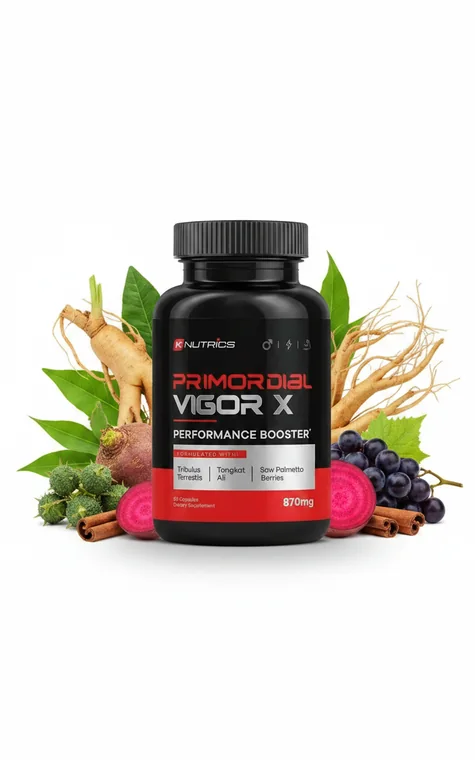
A once-daily 870 mg capsule built on three named botanicals — Tribulus terrestris, Tongkat Ali root and saw palmetto berry. No stimulants, no hormones, and an honest 8 to 12 week trial window.
Order Primordial Vigor X NowCan you take Tongkat Ali and ashwagandha together?
Here is the answer nobody else on this results page gives you: no randomised trial has ever tested the combination. Every effect size quoted above comes from a trial of a single botanical against placebo.
The line you will read repeatedly — "there is no recorded evidence of harm from combining them" — is technically true and close to meaningless. Nobody has looked. Absence of reported harm from an untested combination is an absence of data, not evidence of safety.
There is also a specific reason for caution rather than a generic one. NIH LiverTox, the reference clinicians use, assigns ashwagandha a likelihood score of B — a likely cause of clinically apparent liver injury — based on roughly 23 published cases, onset typically 2 to 12 weeks, predominantly cholestatic or mixed. Most were mild-to-moderate and self-limited, but rare fatal cases and cases requiring transplantation have been reported. Tongkat Ali carries a lower score of D, a possible rare cause, with the reported cases largely in young male bodybuilders where unacknowledged anabolic steroid use weakens the attribution.
Neither score is cause for panic. Both are reasons to read labels and raise it with a clinician if you take medication or have any liver concern.
What the evidence does not show
- Neither is a treatment. Neither botanical has been shown to treat erectile dysfunction or clinically low testosterone. Persistent symptoms deserve a diagnosis.
- Neither has long-term data. The trials cited here run 4 to 16 weeks. What happens over years is unstudied for both.
- Hormone markers are not outcomes. The ashwagandha crossover trial is the clearest demonstration: testosterone moved, and fatigue, vigour and sexual well-being did not.
- Extracts are not interchangeable. Both literatures rest on specific standardised extracts. A label naming the herb but not the standardisation is not automatically the product that was trialled.
- Some popular claims were dropped. Weight-loss, BMI and immune-cell claims for Tongkat Ali circulate on vendor blogs; we could not trace them to a primary human trial, so they are not here.
- There is no head-to-head trial. No study has randomised men to Tongkat Ali versus ashwagandha. This article compares two separate literatures — the best available approach, and still an indirect one.
If you are already taking ashwagandha. Primordial Vigor X contains Tongkat Ali root, Tribulus terrestris and saw palmetto berry — it does not contain ashwagandha, so the two formulas are not interchangeable. It also publishes an 870 mg blend total without a verified per-ingredient breakdown, which means you cannot map it onto the trial doses in the table above. Read both Supplement Facts panels before combining anything.
For the evidence on the three botanicals in that formula, see our pillar review of Tongkat Ali and Tribulus. To judge the category rather than one pairing, the ingredient-by-ingredient verdict matrix grades nine testosterone-booster ingredients against their human trial data.
Medical note: this article is general information, not medical advice, and it reports what trials measured rather than what any product does. Speak to a healthcare professional before starting or combining any supplement, especially if you take medication or are managing a liver, prostate or hormonal condition. Adult men only.
Frequently asked questions
Is Tongkat Ali or ashwagandha better for testosterone?
Tongkat Ali has the better testosterone case. A 2022 meta-analysis in Medicina pooled five randomised controlled trials and reported a standardised mean difference of 1.352 (95% CI 0.565 to 2.138, p = 0.001) for total testosterone. The ashwagandha testosterone signal comes from a single small crossover trial that reported a 14.7% greater rise in salivary testosterone than placebo. Neither result should be read as a treatment for low testosterone.
Is ashwagandha better than Tongkat Ali for stress?
On the published evidence, yes. Ashwagandha has a dedicated stress trial in 64 adults taking 300 mg twice daily for 60 days that reported significantly lower serum cortisol than placebo (p = 0.0006), plus a meta-analysis of five trials in 400 people showing a small but significant benefit on sleep (SMD -0.59, 95% CI -0.75 to -0.42). Tongkat Ali has one 4-week trial in 63 moderately stressed adults reporting a 16% fall in salivary cortisol.
Can you take Tongkat Ali and ashwagandha together?
No randomised trial has ever tested the combination, so there is no evidence either way. Absence of reported harm is not the same as tested safety. If you are considering stacking them, read both labels, add up the total daily amount of each botanical, and speak to a clinician first, especially if you take prescription medication or have any liver concern.
Which one has more safety data?
Both have gaps, and they are different gaps. The NIH LiverTox database gives ashwagandha a likelihood score of B, meaning a likely cause of clinically apparent liver injury, based on roughly 23 published cases with onset typically 2 to 12 weeks after starting. Tongkat Ali is scored D, a possible rare cause, but LiverTox also notes that long-term use and higher doses have not been assessed in humans and that there is no standardisation of purity and concentration across extracts.
Does Primordial Vigor X contain ashwagandha?
No. Primordial Vigor X names three botanicals: Tribulus terrestris, Tongkat Ali root and saw palmetto berry. It does not contain ashwagandha. If you already take an ashwagandha product, the two formulas are not interchangeable, so read both Supplement Facts panels rather than assuming they overlap.
Scientific references
- Leisegang K., Finelli R., Sikka S.C., Panner Selvam M.K. — Eurycoma longifolia (Jack) Improves Serum Total Testosterone in Men: A Systematic Review and Meta-Analysis of Clinical Trials. Medicina 2022;58(8):1047 (PMC9415500)
- Talbott S.M., Talbott J.A., George A., Pugh M. — Effect of Tongkat Ali on stress hormones and psychological mood state in moderately stressed subjects. J Int Soc Sports Nutr 2013;10:28 (PMID 23705671)
- Chandrasekhar K., Kapoor J., Anishetty S. — A prospective, randomized double-blind, placebo-controlled study of safety and efficacy of a high-concentration full-spectrum extract of ashwagandha root in reducing stress and anxiety in adults. Indian J Psychol Med 2012;34(3):255–262 (PMID 23439798)
- Cheah K.L., Norhayati M.N., Yaacob L.H., Rahman R.A. — Effect of Ashwagandha (Withania somnifera) extract on sleep: A systematic review and meta-analysis. PLoS One 2021;16(9):e0257843 (PMID 34559859)
- Lopresti A.L., Drummond P.D., Smith S.J. — A Randomized, Double-Blind, Placebo-Controlled, Crossover Study Examining the Hormonal and Vitality Effects of Ashwagandha in Aging, Overweight Males. Am J Mens Health 2019;13(2) (PMID 30854916)
- NIH LiverTox — Ashwagandha. NCBI Bookshelf NBK548536
- NIH LiverTox — Tongkat Ali. NCBI Bookshelf NBK609015
- NIH Office of Dietary Supplements — Ashwagandha: Is it helpful for stress, anxiety, or sleep? (Health Professional Fact Sheet)
Tongkat Ali, Tribulus and saw palmetto in one daily capsule
If Tongkat Ali is the botanical that fits your goal, the official store handles pricing, shipping and the 60-day money-back guarantee.
Order From Official Store